
The Woman Who Made Mel Rose Couture: A Story for Mother's Day
- Mel

- Apr 25
- 11 min read

Mel Rose Couture founder Mel shares the story of growing up with a seamstress mother, learning to sew, and how one woman's quiet dedication shaped a couture business built from love, craft and a sewing machine gifted on a seventeenth birthday.
Table of Contents
1. The sewing room
2. The woman she was
3. What she passed on
4. The business she helped build
5. The thread that connects us — a note for mothers of the bride
6. A personal note on Mother's Day
7. Four questions I have never quite answered in public — until now
There is a small room I still think about.
It was off my parents' bedroom. A little alcove that was part wardrobe, part storage, and the hub for creating special things. For us, for the family, for anyone who needed something made with care.
Glass lever windows opened onto the front garden and mum’s roses. The smallest room in the house. The most magical, to me.
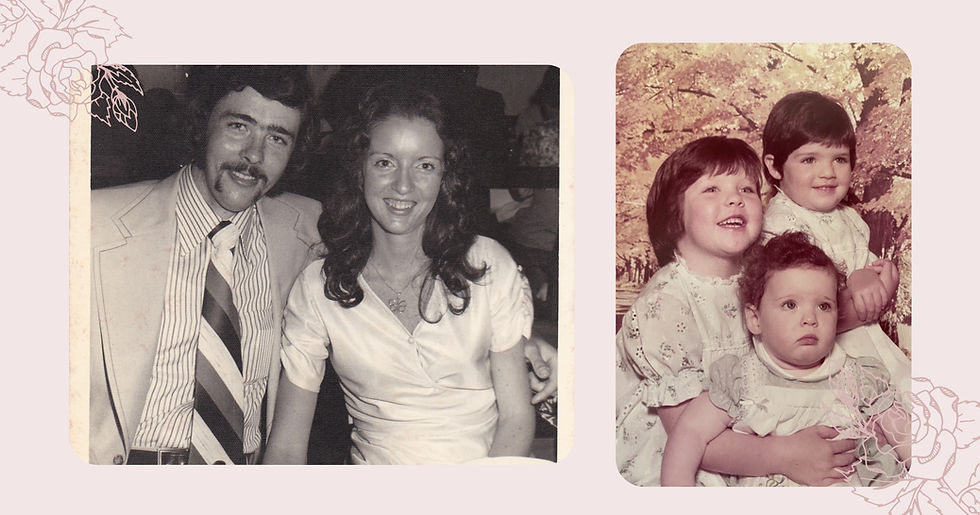
I would sit on the edge of my parents' bed and just watch her. She'd be at the machine, working on a dress for me or my sisters, or tending to the alterations from my dad's menswear store. I don't remember being asked to sit there. I simply wanted to be near it. Near her. Near whatever it was she was making.
I am sharing this story because it is Mother's Day this month, and because I have never quite told it in depth before.
This is the story of the woman who made Mel Rose Couture possible — not once, but many times over.

The Sewing Room
Growing up both of my parents had a connection to clothing in very different ways. My dad was the manager of a menswear clothing store, and my mum made all our special occasion outfits as a home seamstress.
I grew up around quality clothing from both sides of the house — and both parents impressed upon me, in their different ways, that how something is made matters.
I remember running between the racks at my dad's store as a small child. Playing at ringing up sales. Watching him serve customers from around the corner. I didn't realise at the time that it was building something in me — an eye for quality, an instinct for good fabric, an understanding that finish and fit are not afterthoughts.
But it was my mother's world that pulled at me most.
She was always making something. There was always a project. When she sat at the machine she had a particular calm about her — like the world made sense when she was in the middle of creating. I would sit and listen to her stories about getting ready for a dance or a night out when she was younger. She'd decide midweek she wanted something new for the weekend, go to the fabric shop, buy what she needed, and make herself an outfit.
I sat on that bed watching her for years before I ever asked if I could try.
The Woman She Was
My mother was a nurse before she had us. She was someone who cared for people as a vocation, not a job. She brought that same quiet dedication to everything she did at home.
Mum attributes her start as a seamstress to a teacher at school who took the time to pass the knowledge and skills on to her. One teacher. That is all it took to set something in motion that would eventually become a business, two generations later.
Mum never took formal courses after that. She worked briefly at a menswear tailoring company, which helped. But mostly, she just practised. She got better. She trusted the skill.
When I asked her one day if I could try, she sat me down and went through everything. How to thread the machine. What each part did. Where the needle went. How the pedal worked. She was patient. She did not rush any of it.
The first thing I made was a straight line on a scrap of fabric. It came out crooked. The second thing I made was a scrunchie.
I remember thinking — I made that. That feeling did not leave me.
What She Passed On
She made everything that mattered. My year six graduation dress. My year twelve school graduation gown — I remember shopping for the fabric together, choosing the perfect royal blue, standing in the living room while she went back over the fit again and again until it was right. Because that was always what mattered most to her. The fit.
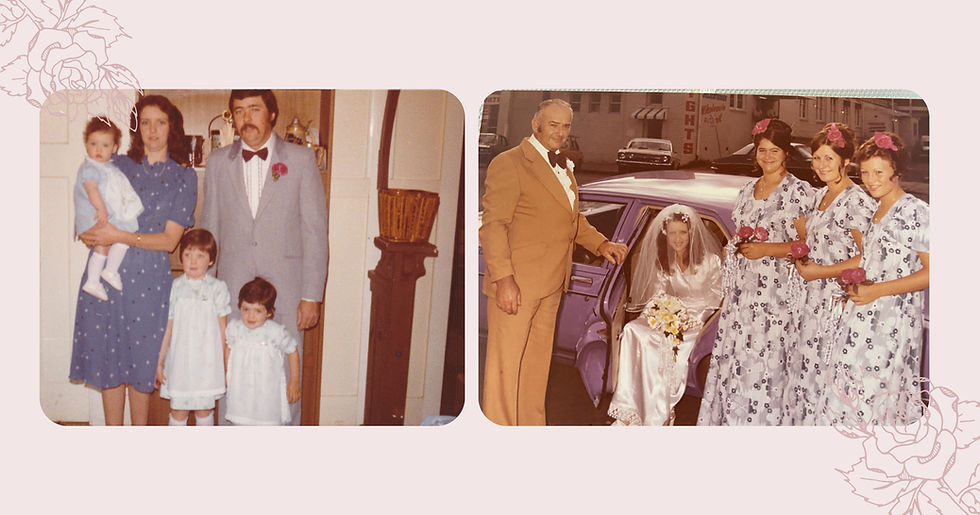
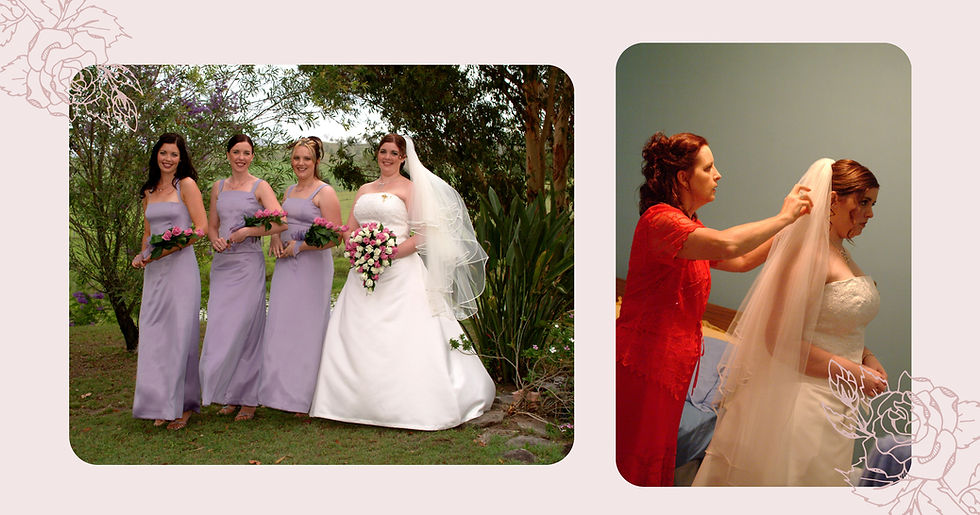
My wedding dress. My bridesmaids lived near her rather than near me, so she made their dresses herself. When my sisters married, we worked on their wedding gowns together — my mother and I, side by side. By then it wasn't just her passing something down to me. We were building things together.
If you look through our family photo albums you will find dozens of pieces across the years. Her love is in every single one of them.
She also helped me through the years when the school system failed me. I was the only student choosing textiles and design in years eleven and twelve. My principal refused to let me attend another school where a teacher could actually teach me the subject. Instead, I had a textbook my mother bought because the school did not provide one, and a supervisor who knew nothing about sewing.
My mother got me through it. She sat with me and worked through the assessments, filled in what the textbook could not give me. I got strong marks. I have never forgotten that meeting with the principal — the door he closed is one I have thought about a lot over the years, because everything that came after, I built without his help.

The Business She Helped Build
In February 2006, things came to ahead. For years I had been taking on small sewing jobs here and there, making cousins' wedding outfits, dresses for my sisters, alterations for friends, all while working in a pharmacy career that was never what I wanted. That last Pharmacy broke me, and I realised that things had to change.
Sitting with my husband unsure of what to do, he asked if i could do anything what would it be. Creating I said. Well, why not start your own business? You love it. You're good at it. Why not do it properly?
I did what I always do when I need to think something through. I called Mum. She said: you can only try.
I went to the newsagent and bought a magazine — How to Start Your Own Business. I read it cover to cover, worked out what I needed to do, and started Mel Rose Couture in a two-bedroom unit in Tweed Heads. With the sewing machine my parents had given me as a gift on my seventeenth birthday.
When it came to naming the business, I was thinking along the lines of something straightforward. It was my mother who said — no. You want something memorable. Something that stands for more. Why not couture?
She named the business. And she named me. Mel Rose was my label even back at TAFE. But the word that made it a couture house — that was hers.
In those early years she would drive hours to visit and then just stay and help. Not watching — helping. Actually making pieces alongside me, one client at a time. The early years of Mel Rose Couture had her hands in them too.

The Thread That Connects Us — A Note for Mothers of the Bride
Something I have never quite said out loud until recently: every mother of the bride or groom who walks into my studio, I see a little of my own mother in her.
I remember shopping with my mother for her outfits for my sisters' and my own weddings. The fit was not right. The options were not designed for her. We went from store to store and nothing quite worked the way it should for a woman who deserved to look extraordinary at her own children's weddings.
I was her daughter standing beside her in those shops, watching her navigate exactly what my clients navigate now. The difference is that my clients find their way to me — and my mother had me there with her.
She did find what she was looking for, in the end. Each wedding, a different outfit. Each one right for the occasion, right for her. They are still hanging in her wardrobe — three dresses full of memories from three of the most important days in our family's life.
When a mother of the bride sits down in my studio, I am not just her designer. I am also, in some quiet way, my mother's daughter — the one who went shopping with her, who stood in those fitting rooms and understood what it meant to finally find something that felt right.
I carry that into every appointment.
The standards I hold in the fitting room, the way I go back over something again and again until it is right — I learned that standing in my mother's living room, watching her do exactly the same thing.
She is in the work whether she is in the room or not.
A Personal Note on Mother's Day
Mother's Day is a little complicated for me personally, if I am honest.
I am deeply grateful to still have my mum in my life — that is not something I take lightly for a single moment. And I am lucky to have my husband's mum and his stepmum, women I love and want to celebrate. There is real joy in the day for me.
But there is something bittersweet in it too. Motherhood in the way I once imagined it was not the path my life took. I have not talked about that much publicly, and I am not going to go into detail here. But I think it is important to say — because I know I am not the only woman who finds this day complicated, who holds gratitude and grief in the same hand.
What I will say is this. The love I would have poured into motherhood went somewhere. It went into Jasper and Molly — my fur babies, fifteen and thirteen years old and completely adored. It went into every client who has sat in my studio. Into every gown I have made for a woman standing at a significant moment in her life. Into the nieces and nephews I adore. And into this business — built from nothing, on a machine my parents gave me at seventeen, with my mum beside me every step of the way.
Mel Rose Couture is my baby. And I am proud of her.
Four Questions I Have Never Quite Answered in Public — Until Now
As part of putting this story together, I sat down and answered some questions more honestly than I have before. These felt worth sharing.
When you think about your mother — not as a seamstress, but as a person — how would you describe her?
My mum was a woman who just got on with things. She was practical and talented in a way that she almost didn't realise — like it was just part of her rather than something she showed off.
She was a nurse before she had us, which tells you something about her. She was someone who cared for people as a vocation, not a job. And she brought that same quiet dedication to everything she did at home.
What I remember most is that she was always making something. There was always a project. She wasn't someone who sat still easily, but when she was at the machine she was completely focused. There was a particular calm about her in those moments — like the world made sense when she was in the middle of making something.
She also had a real sense of fun. The story I always come back to is when she was living in the nurses' college — before she was married, before any of us — and midweek she'd decide she wanted something new for the weekend. She'd go to the fabric shop, buy what she needed, and just make herself an outfit. For a dance, or a night out. That was her. She didn't wait for things to come to her.
You described being failed by your school at a critical point. How did that shape the way you eventually built the business?
I've never forgotten that meeting with the principal. The door he closed is one I've thought about a lot over the years — because everything that came after, I built without his help.
I spent years eleven and twelve sitting in the library by myself, teaching myself the curriculum in the subject I loved most. I had more free periods than anyone else in the school, not because I'd earned them, but because there was nowhere for me to go and no one to teach me. My mum bought me the textbook because the school didn't provide one. She sat with me and worked through the assessments, filled in what the textbook couldn't give me. With no formal support on the school's side at all, her knowledge and her patience were the only real teaching I had.
I got strong marks.
I think that shaped something in me. The understanding that systems don't always make room for you — and that you build anyway. You find another way. That's what I did then, and it's what I did again when I started Mel Rose Couture. I didn't wait for permission.
You work with a lot of mothers of the bride and groom. What do you notice in a woman the moment she walks through the door?
I see someone who has spent years putting her child first. Who has got them to this point and wants them to have the celebration they deserve. There's a particular kind of quiet pride in that — and alongside it, almost always, a quiet exhaustion from having looked everywhere and found nothing that worked.
That's the other thing I notice. She's tried. She hasn't arrived at my door first — she's arrived after the shops have failed her. The fit isn't there. The options aren't designed for her body or her life stage. She's been made to feel like the problem, when the problem was never her.
So she walks in carrying both of those things at once. The significance of the occasion and the frustration of not yet feeling ready for it.
What she needs — and what I always want her to leave with — is to feel amazing and genuinely cared for. Not processed. Not managed. Cared for. That's why I always make a point of congratulating the parents too when a wedding is coming. The day belongs to the couple, but the mother got them there. That deserves to be acknowledged.
She is not an afterthought at this wedding. And she should never feel like one in my studio.
Is there something you want to say to your mother — or about her — that you haven't quite put into words before?
I'm not sure I have the words even now. But I'll try.
You taught me that making something with your hands is an act of love. You showed me that before I could read a pattern, before I knew what a selvage was, before I understood any of it — just by letting me watch you, and then by letting me try.
You sat with me through the years when the school system failed me. You drove hours to help me sew for strangers when I was just starting out. You made my bridesmaids' dresses because they lived near you and I didn't. You worked beside me on my sisters' wedding gowns. You suggested the word that became the name on the door.
And when I called you — not knowing if I was brave enough to start something of my own — you said: you can only try.
I think about that a lot. The simplicity of it. You didn't promise it would work. You didn't tell me I was talented or that success was inevitable. You just reminded me that trying was enough to begin with. That turned out to be exactly what I needed to hear.
Mel Rose Couture exists because of a teacher who inspired you, and because you passed what she gave you down to me. It exists because of a sewing machine you and Dad gave me on my seventeenth birthday. It exists because you never once suggested I let it go during the years it was quiet.
I send you photos now and you send back the same thing every time. So proud of you. It's beautiful work. Your client should be so happy.
After 39 years of sewing being part of my life, you still have my back.
Thank you, Mum
If you have a special occasion ahead and would love to feel extraordinary in it,
I would love to help you get there.
Fill out the enquiry form: www.melrosecouture.com.au/contact
From my heart to your wardrobe,
Mel 👗



Comments